
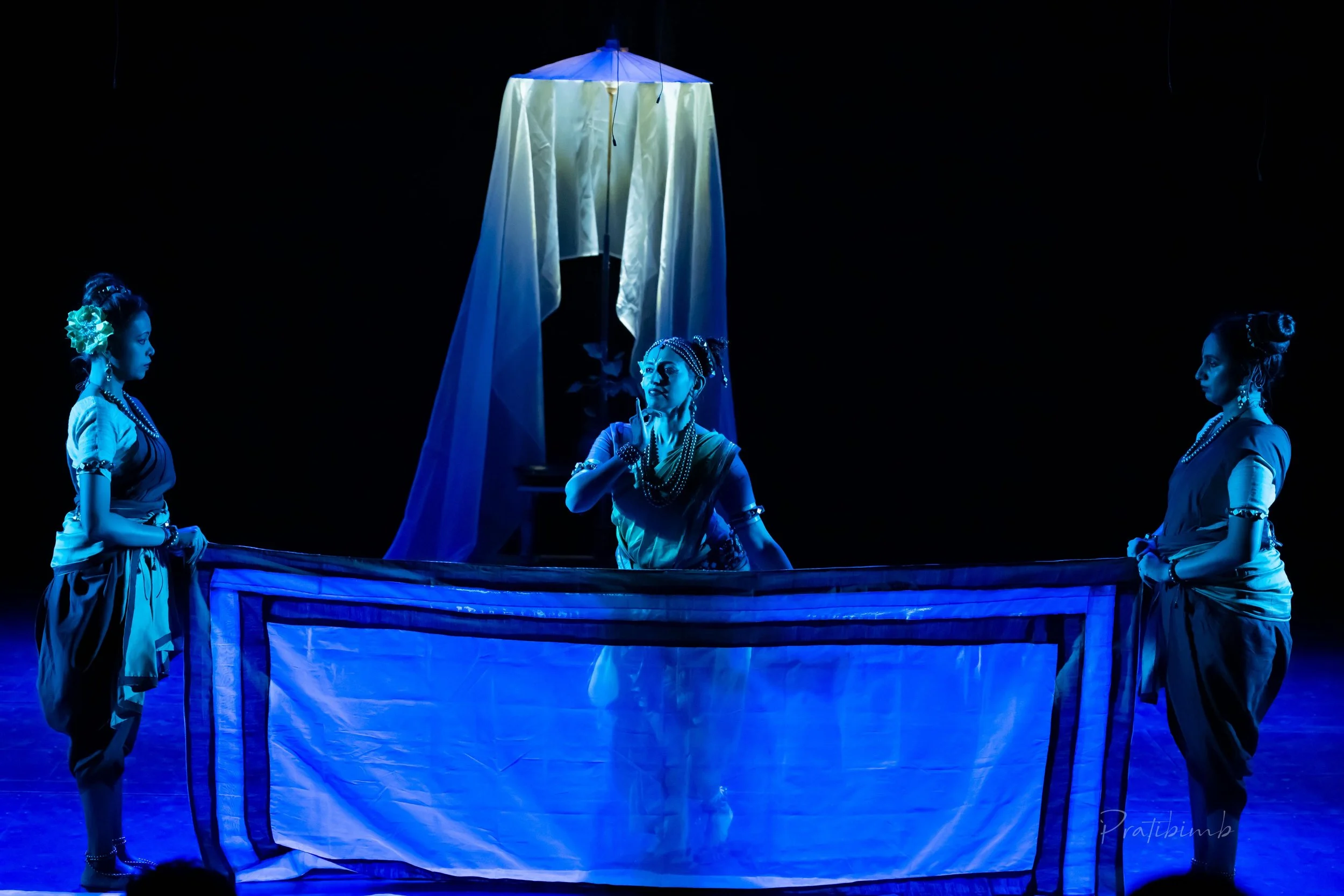
FeatureD shows
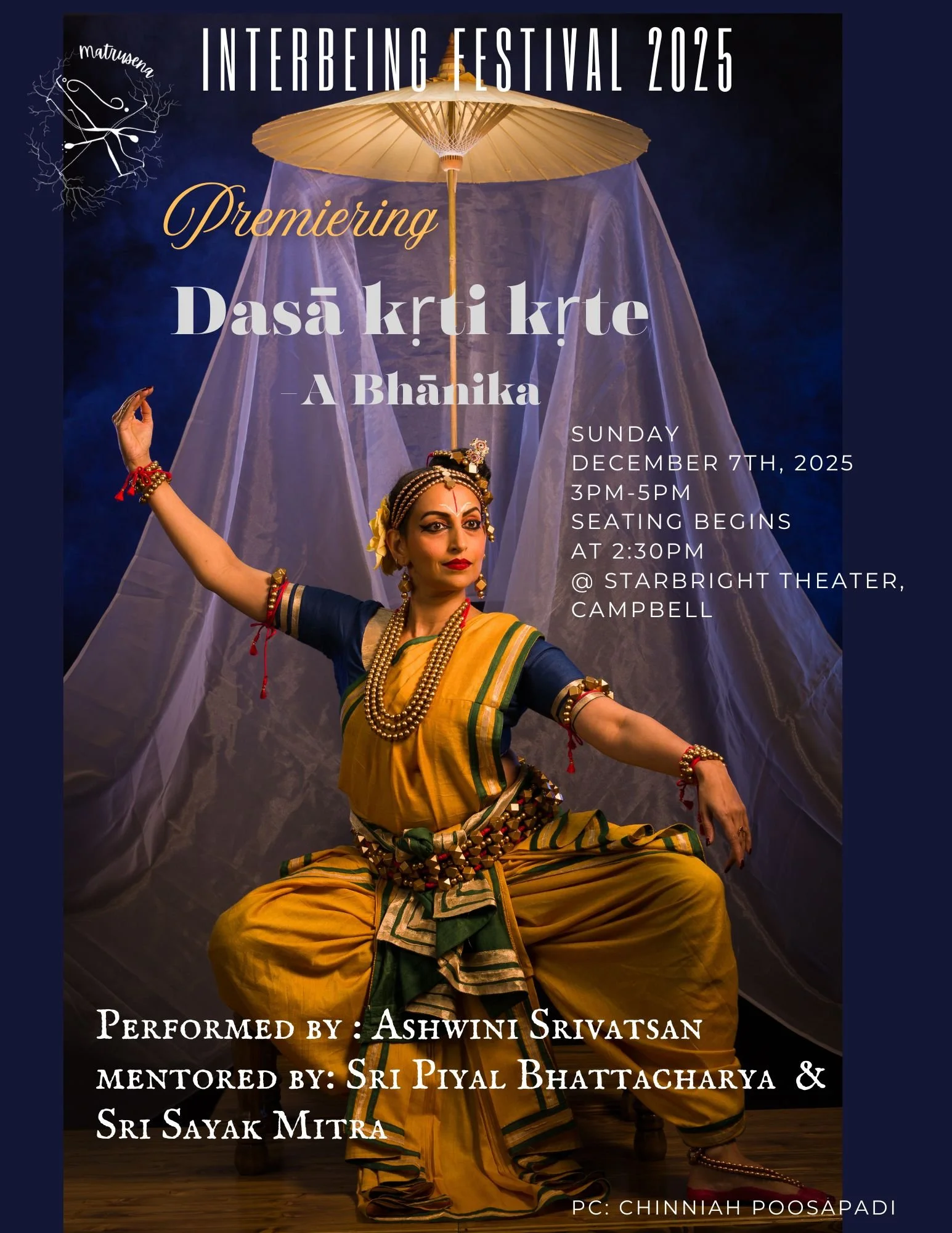
Explore the magic of Bhanika
-A method of Indian story telling that is deeply rooted in the knowledge system of the Natya Shastra
About Bhāṇikā
Bhāṇikā is a reconstructed Uparūpaka—a short, one-act monologue traditionally performed by a solo female artist who uses acting, dialogue, dance, and music to narrate stories, much like a Sūtradhāri. It often depicts playful episodes, heroic feats, or divine narratives such as Kṛṣṇa’s Līlās and the valor of Viṣṇu’s incarnations. Highly expressive and nuanced, it blends gesture, rhythm, and melody into a refined aesthetic language.
In this production, the Dasāvatāra narrative is envisioned as symbolic stages of human existence—from birth to dissolution—interpreted through Vajrayāna Buddhist thought. It also draws from rich literature of the Visishtaadvaita philosophy and Jayadeva’s Gita Govindam. The work interweaves Sanskrit, Hindi, Brijbuli, Avahat, and Tamil to make its philosophical themes widely accessible.
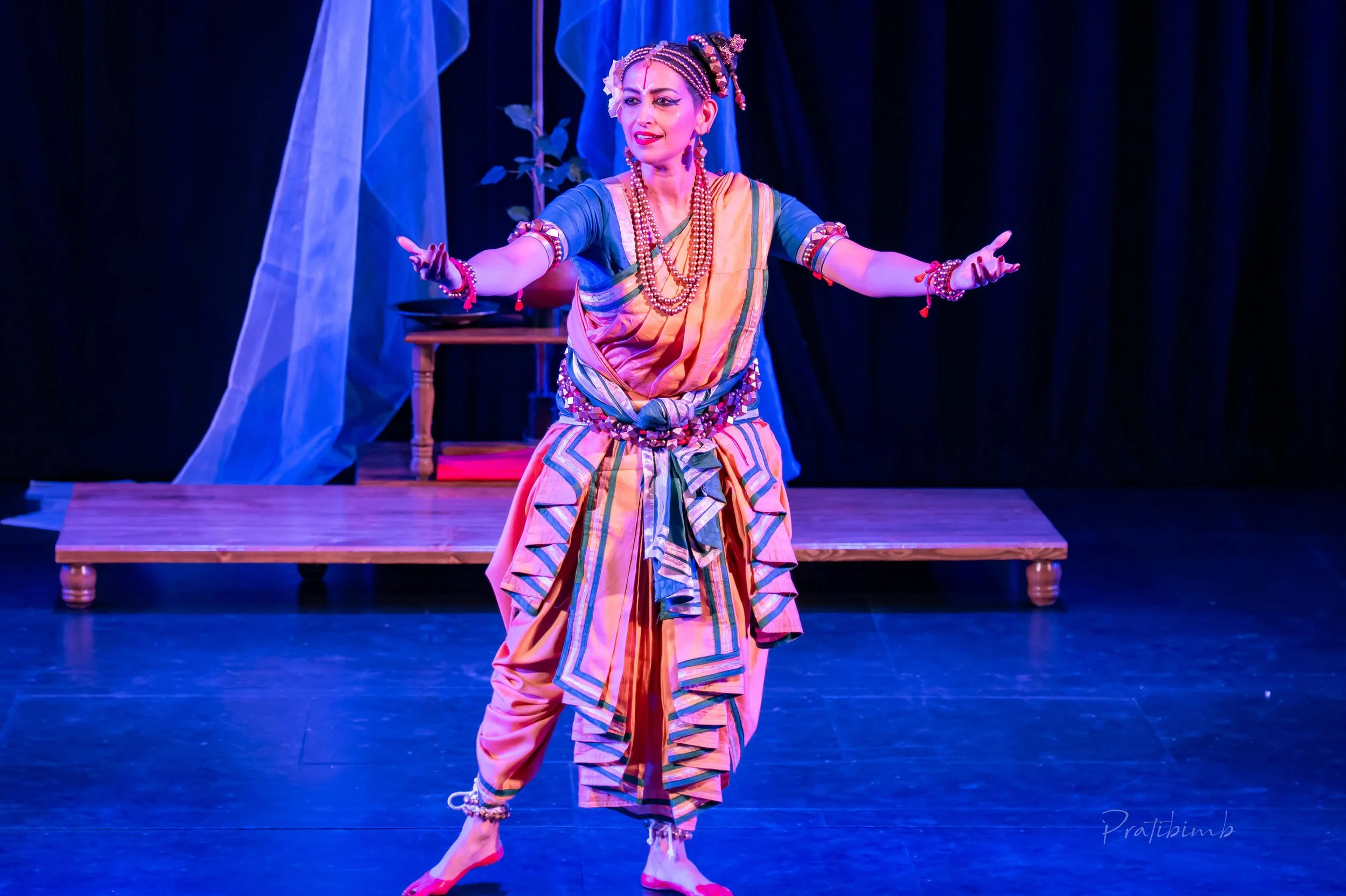
“I haven’t witnessed any other show where I’ve been so emotional for such a sustained period of time! Truly moving performance!”
- A Sahrdaya
Marga Natya
The term ‘Mārga’ denotes the path — the wisdom transmitted through tradition (Paramparā) and the pursuit of spiritual realization. Mārga Nāṭya is both an artistic and pedagogical process developed through extensive research that seeks to revive Bharata’s original principles by harmoniously integrating music (Gītam), instruments (Vādyam), dance (Nṛtyam), and drama (Nāṭyam) within a spiritual framework. This Bhanika is a result of Ashwini Srivatsan’s personal journey and training in the Marga system.
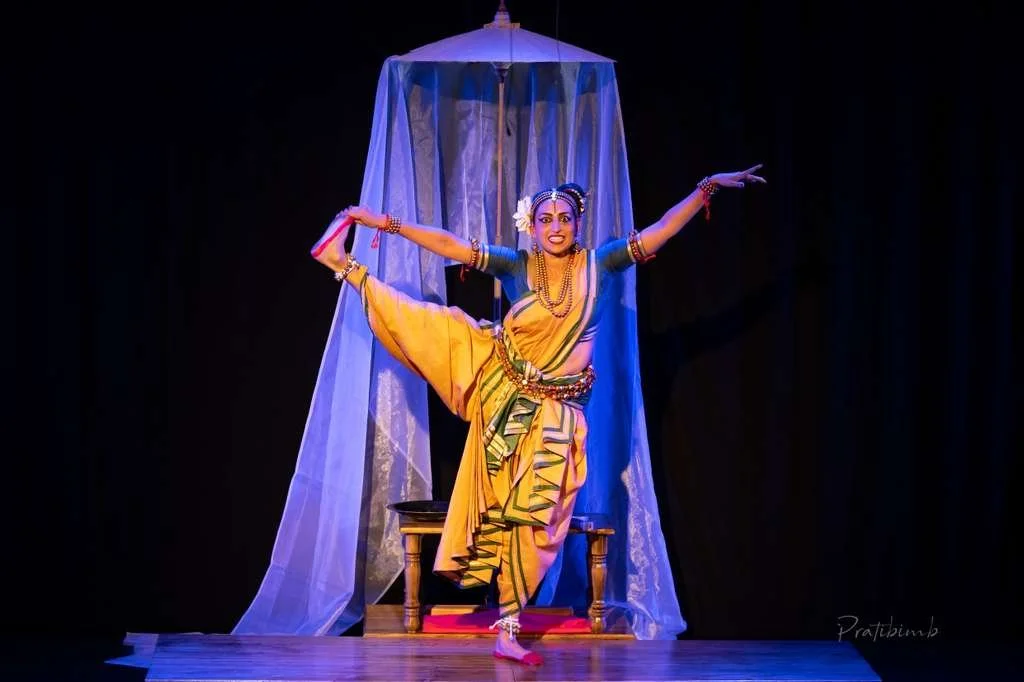
‘A show worth remembering’
- A Sahrdaya
Meet the Artists
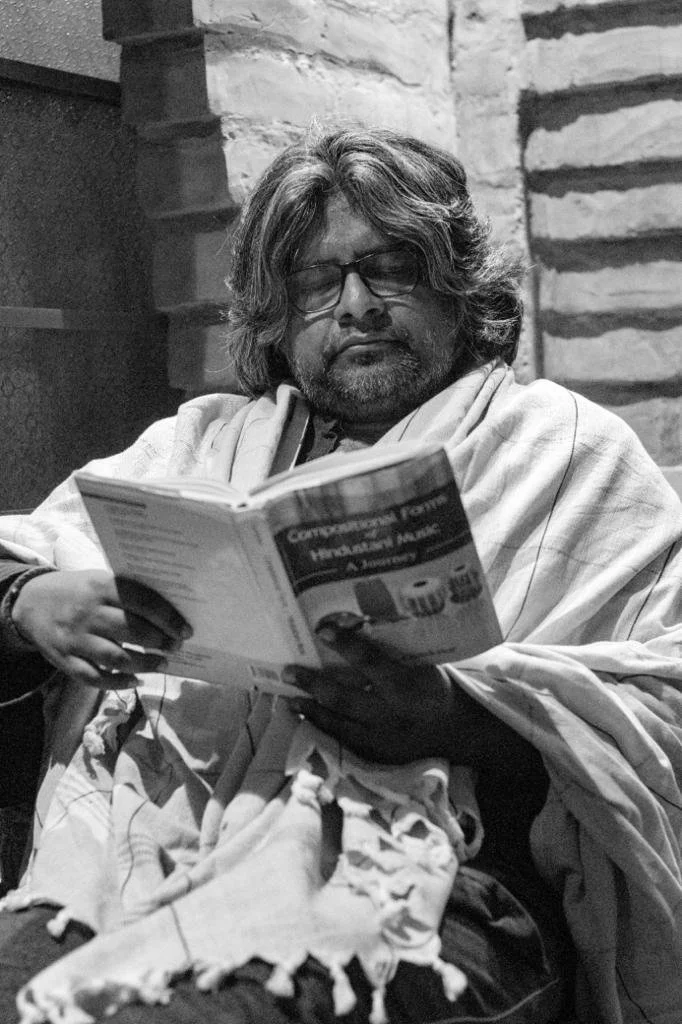
Piyal Bhattacharya
Mentor, Director
Shri Piyal Bhattacharya is a leading expert on the Nāṭyaśāstra—the classical treatise on Indian performing arts. He is also a Tagore Research scholar, Indian theatre director and a Sanskrit scholar . After having trained in Kathakali at Kerala Kalamandalam, Bhattacharya pursued extensive study of the Nāṭyaśāstra and Indian musicology to uncover and reconstruct lost traditions of Sanskrit theatre. In an effort to safeguard intangible cultural heritage he traced the migration of the ancient Indian harp from Myanmar, thus revitalizing a two thousand year old knowledge system called the ‘Gandharva tradition’. Piyal Bhattacharya has directed a wide range of Sanskrit plays and dance dramas, including Chitra Pūrvaraṅga, Bhāṇaka, adaptations of Kālidāsa’s Meghadūtam, and the acclaimed Jimuta-Hṛdayam based on Śrīharṣa’s Nāgānanda, presented at major national and international theatre festivals. Piyal Bhattacharya is a ‘Sangeet Natak Akademi awardee’. He was conferred with the honorary title of ‘Mahāmahopādhyāya’ by Dr. Puru Dadheech, acknowledging Bhattacharya’s significant contributions to Sanskrit theatre and revival of ancient Indian performing arts. He is lauded as the “Guru of a Lost Tradition” by the Indian media.
Ashwini Srivatsan
Artist
Ashwini Srivatsan is a performer, educator, and researcher, and serves as the Creative Director of Kanha School of Dance in the Bay Area, California. Trained in Bharatanatyam and Bharata Nrityam, she integrates traditional practice with in-depth study of the Nāṭyaśāstra, the Karaṇas, and the metaphysics of movement—how emotion, meaning, and form arise through the moving body. She was conferred the title “Marga Tattva Kovida” by Chidakash Kalalay in March 2024.
With over 25 years of training, Ashwini began her journey under Smt. Sundari Santanam, foremost disciple of Dr. Padma Subrahmanyam, and later continued under Smt. Nirmala Madhava at Pampa Academy of Dance after relocating to San Jose, CA. Her dance education includes training in Kathak, Jazz, and Contemporary dance, alongside training in Hindustani and Carnatic vocal music and the Veenai under her mother, Vyjayanthimala Sridhar.
Ashwini began teaching as the founder of Mani Paduka Nrityashala in New Mexico, later joining the faculty of New Mexico State University, where she taught a graduate-level course in Bharatanatyam. In 2008, she co-founded Tattva Dance Academy, developing a unique curriculum that blended Indian and Western dance techniques.
Her artistic journey continues under the guidance of Shri Piyal Bhattacharya and Shri Sayak Mitra, through whom she has engaged deeply with the Karaṇas, Aṅgahāras, Maṇḍalas, Gandharva music, Vācikābhinaya, classical Indian philosophies (Nyāya, Vaiśeṣika, Sāṅkhya, Yoga, Vedānta, Kashmir Śaivism), martial arts, Chandas, and Maṇḍala training.
AMUGDHA MALYADA
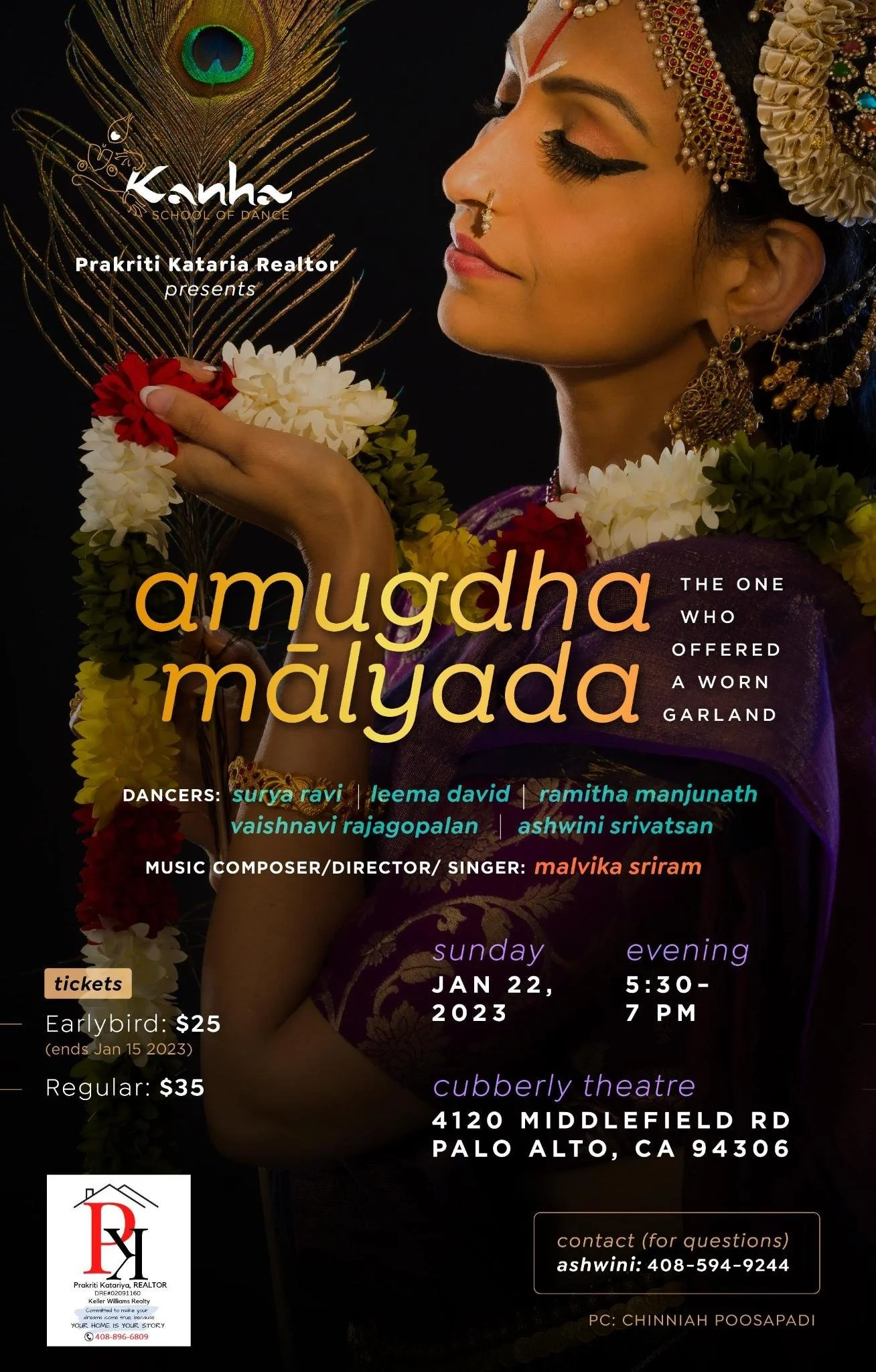
‘Amugdha Malayada’ – One who offered a worn garland is a beautiful interpretation of this magical story of Andal using a movement vocabulary that is at least 2500 years old. The movements are based on Charis and Karanas from the Natya Shastra. Karanas are full body movements that are used to convey meaning and emotion. This Angika abhinaya – or the use of the whole body to give a reverberative suggestion brings about an Alaukik or transmundane experience for the audience. These movements frozen in time were sculpted on the temple walls of Chidambaram, Tanjore, and Kumbakonam. Padma Bhushan Dr.Padma Subrahmanyam, a dancer and research scholar was instrumental in first reconstructing these movements through literature and sculptural references. Piyal Bhattacharya, a dancer, research scholar and director and recipient of the prestigious Tagore scholarship has also immensely contributed to the study of the Natya Shastra. His research takes a holistic approach to the Natya Shastra where the music, dance and dramatic elements of the Natya Shastra come together in a beautiful confluence. Both of these pioneering artists Dr.Padma as well as Sri Piyal Bhattacharya have offered their own unique perspective in the field of Natya Shastra and dance. Ashwini Srivatsan, artistic director of ‘Amugdha Malyada’ has been fortunate to study both perspectives resulting in a deep understanding of the Natya Shastra. Therefore Ashwini brings to Amugdha Malyada a perspective that is an amalgamation of various methods of interpretation that will resonate with the audience.
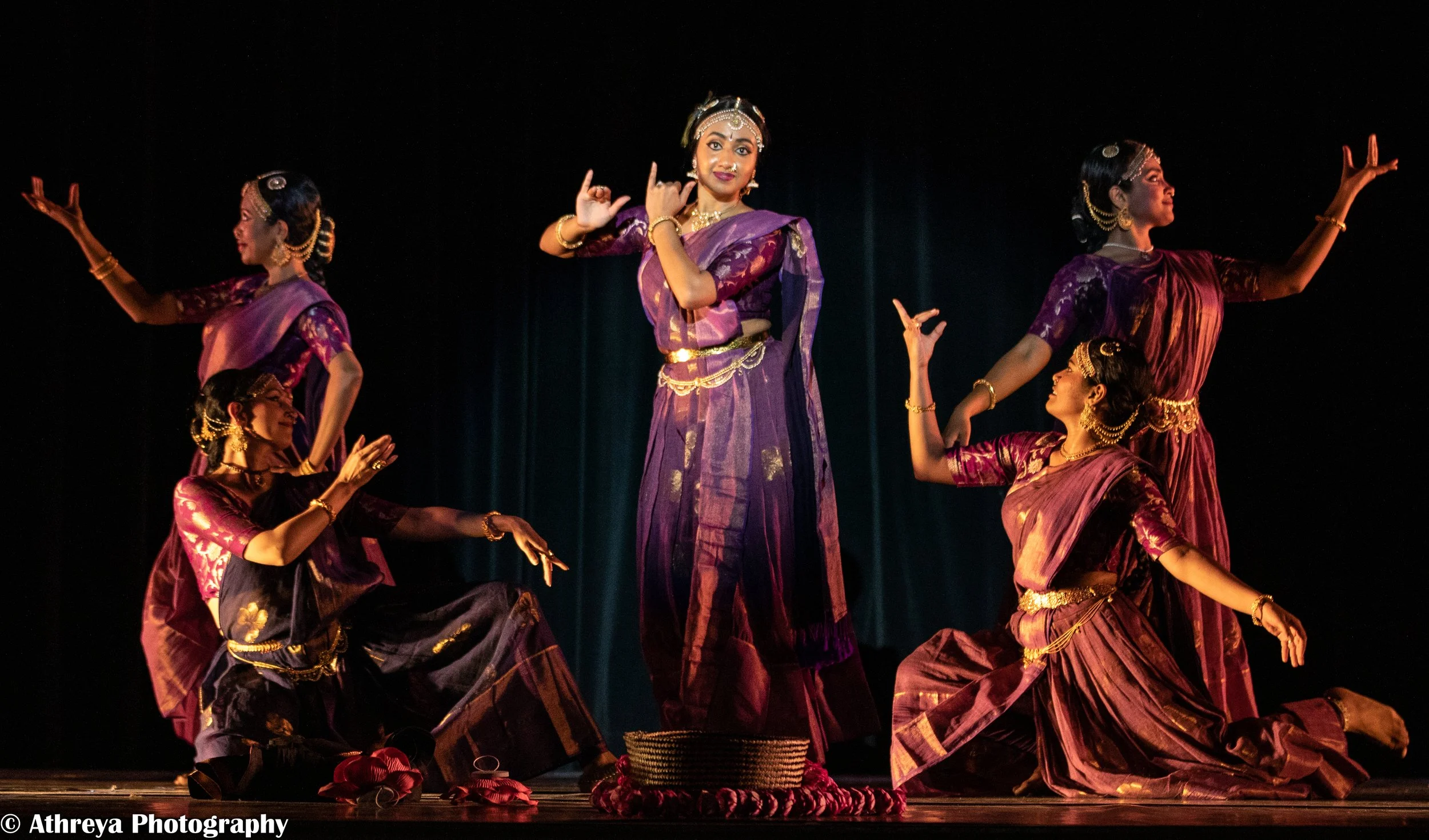
The creative process brings the talent and thought of the artists combined to create an individualized group choreography. Heavy and creative use of Angika abhinaya , going beyond the traditional presentation that so many are accustomed to. Surya Ravi, Leema David, Ramitha Manjunath and Vaishnavi Rajagopalan who are well established dancers in the Bay Area have collaborated with Ashwini Srivatsan on this project.
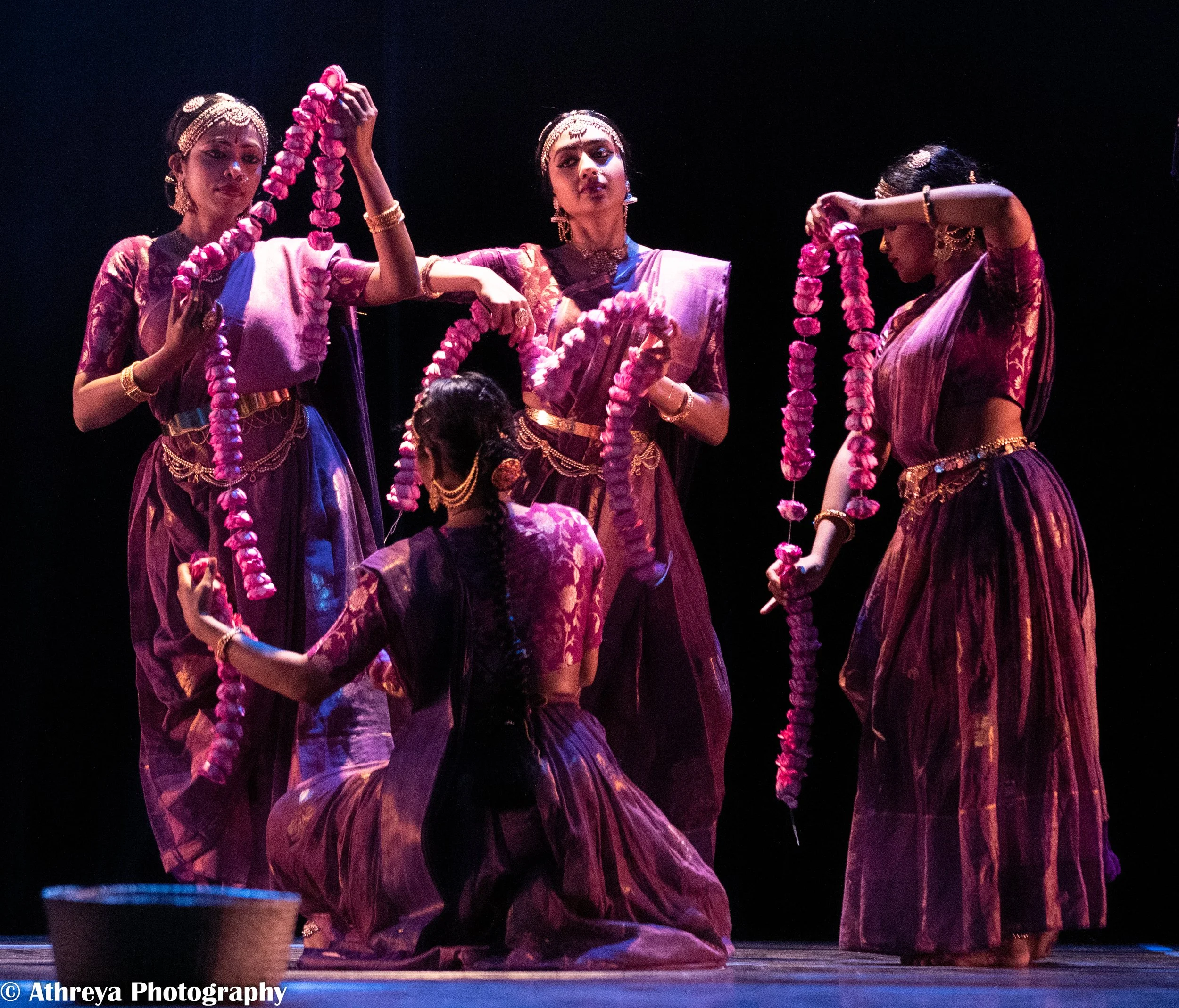
The music for this production is composed and created for the show by local Bay Area artists. Malvika Sriram, an up and coming artist in the field of both western and Carnatic music has scored the music for the show. Accompanying her are well known Bay Area musicians - Jayadev Bhaskaran on Mridangam , Adithya Satyadeep on Violin, Tejasvi Chakravarthy on Flute and Hrishikesh Chary on Veenai.
Amugdha Malyada contributors include- D.V Prasanna Kumar has composed the Kamsa and Hamsa jatis, Mala Sridhar has composed the Angahara and the lyrics for the Andal Tulasi Varnam are written by Smt. Dwarki Krishnamurthy.